Added to your cart
Edit cartTaxes included
Delivery: 2–4 business days · Belgium
Over 1,000 trade customers use Safe-Shield Activate your trade account
The recommended starting combination is Max Cut with the green Max Cut polishing pad . Always adjust your technique and machine settings to the paint, defects and test spot.
Finishing requirements: On many paints, a short finishing stage is sufficient after working the compound thoroughly. Sensitive, soft or very dark paint may require more careful refinement. Remove polishing oils before applying paint protection. Do not use in direct sunlight or on hot surfaces.
All the pads listed work with Max Cut. For a straightforward starting point on most paints, use: Max Cut compound + green Max Cut pad . The other options let you adapt the combination to the paint, defects and technique.
Basic rule: Start with the green standard combination and a test spot. If the correction is insufficient, consider Ultra Cut, microfibre or Wool to suit the job.
More severe car wash scratches, swirls, visible wear marks, heavy dulling and weathered paint. Defects that penetrate the clear coat cannot be safely polished out. Results and pad choice depend on the paint, machine and defect depth.
We recommend Perfect Finish for maximum gloss and clarity. Max Cut has a particularly long working time on a dual action polisher, so many paints only need a short finishing stage. Sensitive, soft or very dark paint may need more careful refinement.
Start with the green Max Cut polishing pad. It is the recommended standard combination for most paints. Ultra Cut, microfibre and Wool offer specialist options for very hard paint, GRP or experienced users.
On suitable paints, Max Cut can produce a very clear finish with a less aggressive pad. However, Black-One remains the dedicated one-step option in the Safe-Shield system. Max Cut is primarily designed for heavy defect correction.
Yes. Max Cut is suitable for both machine types. It offers a particularly long, controlled working time on a dual action polisher. Always adjust your technique, pressure and machine settings to the paint, pad and defects.
Regularly remove compound and paint residue using compressed air or gentle brushing. Switch to a fresh pad if performance drops or heat increases. After use, clean with lukewarm water and pH-neutral soap, then allow the pad to dry completely.
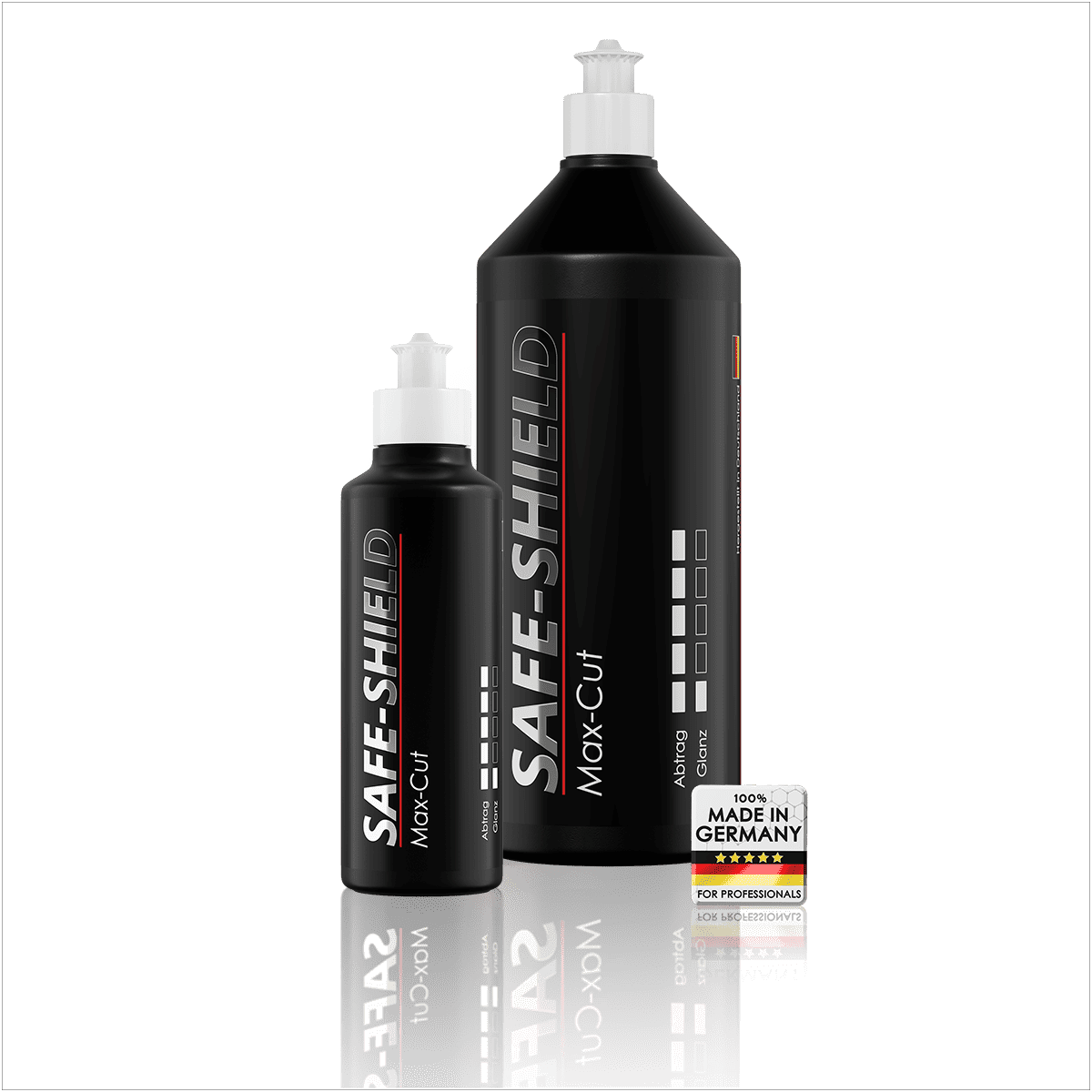
Conventional cutting compounds often achieve heavy cutting at the expense of dust, clogged pads and time-consuming refinement. We developed Max Cut to avoid these problems: it works without dust, offers a particularly long working time on a dual action polisher and leaves a comparatively clear finish despite its strong defect correction. On many paints, a short finishing stage is all that is needed afterwards.
Typical areas of application
When you want to correct more noticeable paint defects/scratches while keeping the subsequent finishing effort as low as possible.
Scratches that go through the clear coat cannot be removed. Always test the result and required pad combination on a small area first.
Stage 1 in the Safe-Shield two-step system
Max Cut handles intensive defect correction. Perfect Finish then removes remaining polishing marks and delivers deep gloss, with pad choice allowing the combination to be tailored to the paint and defects.

Regulation (EC) No 1272/2008: The mixture is not classified as hazardous under Regulation (EC) No 1272/2008. Components determining labelling: The treated article contains biocidal products as preservatives. P102: Keep out of reach of children. Supplemental information: EUH208: Contains reaction mass of 5-chloro-2-methyl-2H-isothiazol-3-one (EC No 247-500-7) and 2-methyl-2H-isothiazol-3-one (EC No 220-239-6) (3:1). May produce an allergic reaction. Safety data sheet available on request.
Additional characteristics: None