
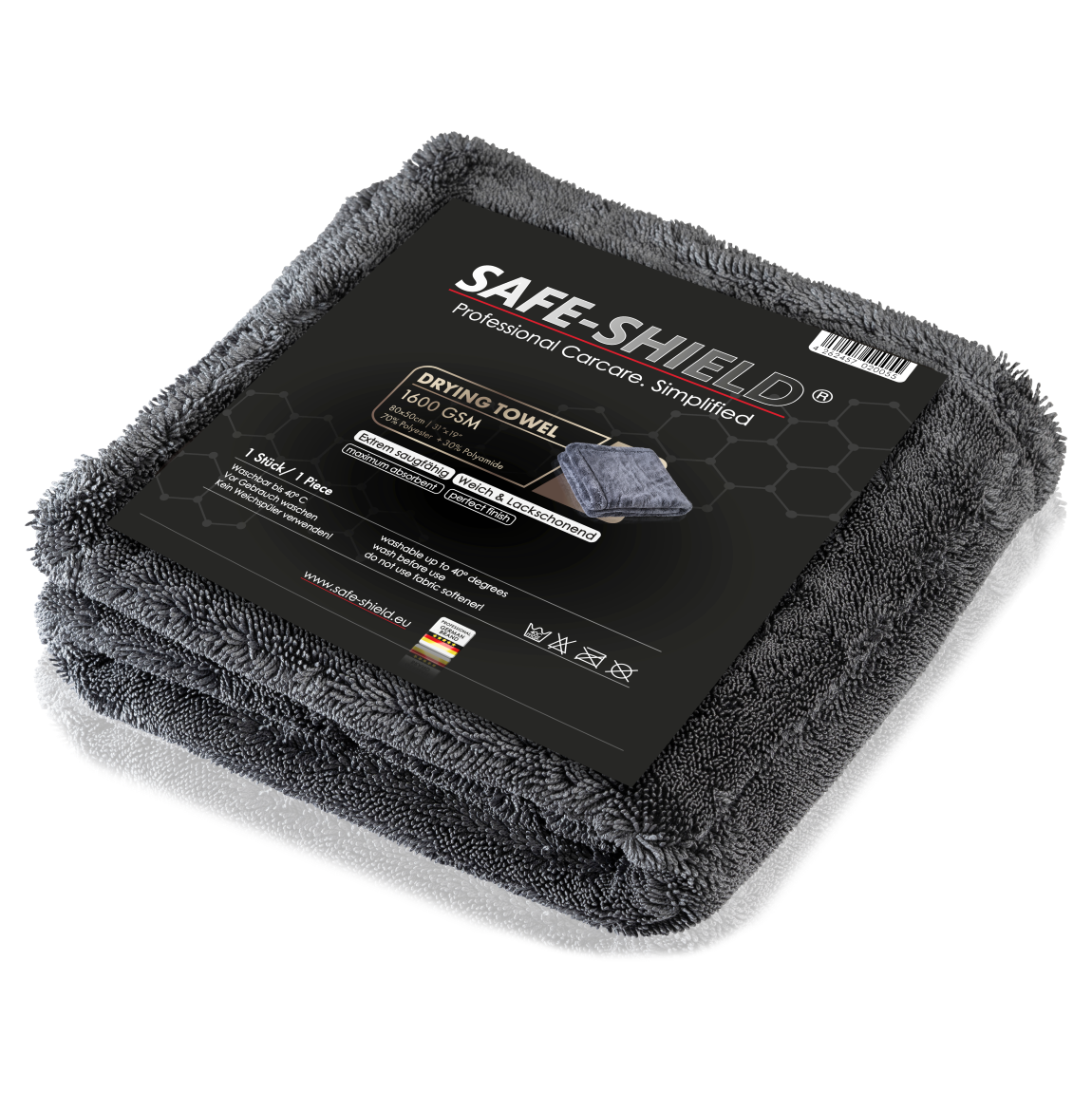
The best way to dry your car after a thorough wash is with a clean, absorbent microfiber drying towel. Lay it on the wet paint and gently pull it across the surface without additional pressure. Work from top to bottom and remove remaining water from mirrors and gaps separately. This reduces the risk of mineral-rich droplets drying on the paint.
Our car drying towel with 1600 GSM and 80 × 50 cm is made for this task. Here you’ll learn how to use it correctly, when you need a second towel and what helps against streaks or already visible water spots.
Why should I dry my car after washing?
When a water droplet evaporates, dissolved minerals can remain on the surface. These rings become visible particularly quickly on dark paint. Sun and warm panels make droplets dry out faster. That’s why you prepare the drying towel before washing and dry immediately after the final rinse.
Driving the car dry is not a reliable alternative. Airflow will not remove all droplets. Water from mirror housings, number plate areas or trim can later run over paint that is already dry. A ceramic coating does not replace drying either: it changes the water behaviour but does not remove dissolved minerals from the water.
Which drying towel do I need for my car?
Choose a soft microfiber towel that is explicitly designed to absorb larger amounts of water. A small all-purpose towel serves a different role and will saturate more quickly on large wet surfaces. Fiber structure, size, absorbency and, above all, cleanliness are what matter.
The Safe-Shield 1600 GSM drying towel uses a twisted-loop structure and measures 80 × 50 cm. “GSM” refers to the fabric weight in grams per square metre. A high number alone is not general proof of quality; the towel must be easy to handle and reliably absorb water.
For a Golf-class vehicle, one of our 1600 GSM drying towels may be enough. For larger vehicles, a lot of remaining water or very clean final drying, you should have a second one ready. Change the towel as soon as it mostly spreads water instead of absorbing it. Rubbing harder won’t make a saturated towel more absorbent.
Drying your car gently in 5 steps
- Only dry fully washed paint. After the contact wash, rinse off the shampoo thoroughly. If visible dirt remains, wash that area again first; the drying towel is not a tool for leftover road film. You can find the full process under how to wash your car properly.
- Check the towel. Inspect both sides for sand, hard particles and matted fibers. Only use a clean towel. If it falls on the ground, set it aside until it has been thoroughly washed and take a different one.
- Start at the top. On the roof and bonnet, lay the cloth flat and gently pull it off in short passes. Do not apply extra pressure. Hold it on side panels so that no corner touches the ground. Work section by section downwards.
- Watch saturation and remaining water. Use an area of the towel that can still absorb moisture or switch to a second towel. On mirrors, trim and license plates, a suitable car dryer with clean air can help. Follow its instructions for use.
- Dry details separately. Carefully catch any remaining drips. Use a dedicated towel for door jambs and other areas that tend to get particularly dirty. Keep wheel towels separate from paint towels.
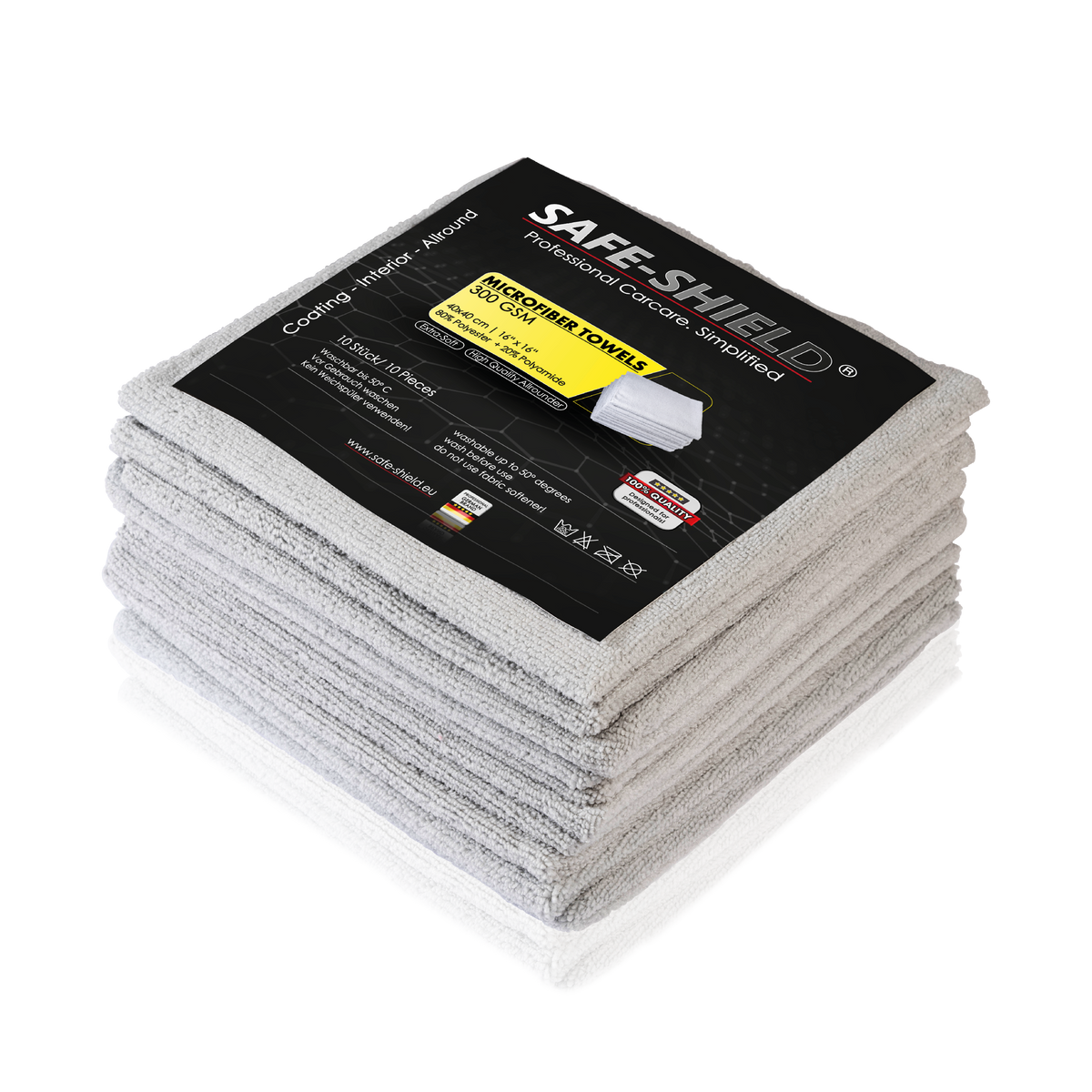
For small remaining droplets on suitable detailed areas, you can keep a clean Coating & Allround microfiber towel ready. It complements the large drying towel; it does not replace its water absorption across the whole vehicle.
Why do streaks or water spots appear even when using a drying towel?
The towel pushes a film of water ahead of it
First, take a fresh drying towel. If this works well, the first one was probably saturated or contaminated with care product residues. Wash it according to its care instructions. If the fresh towel also smears, check whether shampoo or other products were not rinsed off completely.
New droplets appear after drying
Check mirrors, door handles, trim and license plates. Remove any remaining water there with a suitable air dryer or pick up the trailing droplets with a separate clean towel. This way you don’t have to rework the entire surface.
Stubborn light-coloured edges remain
First rewash fresh spots with a suitable shampoo, rinse and dry immediately. If mineral residues remain, a water spot remover or acidic speciality cleaner approved for the surface may be necessary. The selection is explained in the section on acidic cleaners. Changes already present in the paint cannot simply be wiped away dry.
How do I care for my car drying towel?
Wash our 1600 GSM drying towel at a maximum of 40 °C / 104 °F without fabric softener. Keep it separate from heavily soiled wheel or polishing towels. After use, don’t leave it bunched up while damp; wash it and let it air-dry completely laid out flat.
Then store it dry and protected from dust. A clean, dry car wash bucket with lid can help when transporting wash accessories; damp towels should not be kept sealed for long periods. You’ll find the full instructions under How to wash car microfiber towels properly.
Q&A: Drying your car
Should I wet the drying towel beforehand?
You don’t need to pre-soak the Safe-Shield drying towel. Use it clean and absorbent on the washed, wet vehicle. Once it is fully saturated, it has less capacity left for the water on the car.
Can I dry the car in the sun?
Work in the shade on cool surfaces whenever possible. In the sun, droplets can dry in before you reach them. If necessary, wash and dry smaller sections one after another.
Is a drying towel better than a chamois?
For our wash process we recommend a soft, absorbent microfiber drying towel: it can be guided without additional pressure and absorbs a lot of water. Cleanliness and correct use remain crucial with any material.
Do I still need to dry the car after an osmosis rinse?
Low-mineral rinse water can reduce residues. However, it does not guarantee completely spot-free drying, for example if tap water remains in gaps. Check the result and gently remove remaining water.
May I use the paint drying towel to dry the wheels as well?
Use a separate towel for this. Brake dust and other particles should not later end up on the paint.

Deja un comentario
Todos los comentarios se revisan antes de su publicación.
Este sitio está protegido por hCaptcha y se aplican la Política de privacidad de hCaptcha y los Términos del servicio.