
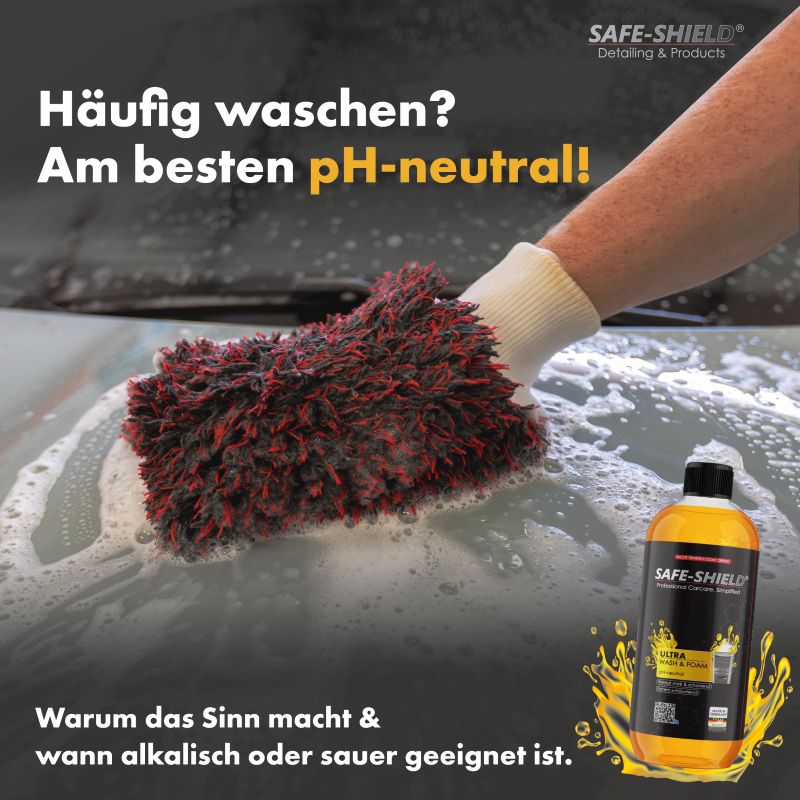
You wash your car gently by first removing heavy dirt without contact, then washing the paint with pH-neutral car shampoo and a clean wash mitt, and finally rinsing and drying thoroughly. Work on cool panels in the shade. Two separate wash buckets help prevent constantly carrying dirt from the mitt back into the shampoo solution.
For regular hand washing, our Wash & Foam car shampoo is the right base. This guide walks you through the entire process and explains exactly when you need an acidic or alkaline specialty cleaner – and when a normal wash is enough.
What do you need to wash a car?
- Car shampoo: Wash & Foam for pH-neutral bucket washing and, if required, as snow foam.
- Two clean buckets: One for shampoo solution, one for clear rinse water. With the Safe-Shield car wash bucket you can choose 12 or 20 litres as well as a grit guard and lid to match your setup.
- Wash mitt: A clean microfiber wash mitt for the paint; ideally a separate one for particularly dirty lower areas.
- Drying towel: The 1600 GSM car drying towel absorbs the water after rinsing. A second towel as backup is useful for large vehicles or when there’s a lot of residual water.
- Water and wash bay: Sufficient water for thorough rinsing and a designated wash area. Check whether your own cleaners and buckets are allowed.
If you are putting together the basic kit: The Starter Pro car wash kit includes a 20-liter bucket with grit guard but without lid, 750 ml Wash & Foam, 750 ml Ultra Wheel Cleaner, a wash mitt and a drying towel. For the classic two-bucket method you will also need a second bucket.
Wash buckets with grit guard: choosing the right size and using the two-bucket method
Washing your car properly in 6 steps
1. Prepare the vehicle and clean the wheels separately
Allow paintwork and wheels to cool down and, if possible, park the vehicle in the shade. Get everything ready before you start. Clean the wheels with dedicated tools and separate water, preferably before washing the paintwork so that any splashes are rinsed off afterwards. The full process is described in the article Cleaning wheels properly.
2. Remove heavy dirt without contact
Rinse off sand, mud and loose deposits with water. When using a pressure washer, follow the distance and usage instructions of the machine and vehicle manufacturer. Do not use a rotary dirt blaster on automotive paint. Never rub dust or insect remains off the paint when dry.
For additional pre-cleaning you can apply Wash & Foam with a suitable foam cannon. Mix approx. 100 ml of our shampoo with 1 liter of water in the tank; the cannon adds more water. Follow the instructions for your container and foamer, do not let the solution dry, and rinse it off completely. The foam does not reliably replace the subsequent contact wash.
Using Snow Foam correctly: explained dosing and pre-wash
3. Prepare shampoo and rinse buckets
Fill the wash bucket with the appropriate shampoo solution and the second bucket with clear water. Dose our Wash & Foam at 60 ml per 10 litres of water. The amount of water you actually fill in is what counts, not the maximum bucket size. Suitable grit guards can help support dirt separation.
To keep the process clear: Wet the mitt with shampoo water, wash a small section, rinse thoroughly in the second bucket and only then reload with shampoo water. If the water becomes noticeably dirty or particles remain in the fibres, replace or clean thoroughly.
4. Wash the paintwork from top to bottom
Start with the roof and upper surfaces. Glide the well-soaked wash mitt over the paint with light pressure in manageable passes. Rinse it out after each section. Lower doors, sills and heavily soiled areas come last. Do not go back over the roof with a mitt that has been used on these lower areas.
Keep the surface wet. If shampoo starts to dry prematurely, rinse off that section and continue working in smaller areas. If a stubborn deposit remains, remove it later in a targeted way; vigorous scrubbing is not a shortcut.

5. Rinse off all shampoo completely
Rinse the vehicle systematically from top to bottom. Also remove foam residue from mirrors, trim and door handles. Before drying, check whether any dirt is still visible. If it is, rewash that area instead of rubbing it with the drying towel.
6. Gently dry immediately and clean tools
Place the clean drying towel on the wet paint and gently pull it off without applying extra pressure. Work from top to bottom, check for drips from gaps, and switch to a fresh towel once it’s saturated. Use separate towels for wheels and door sills.
After washing, rinse out the buckets and grit guards. Wash mitt and towels according to their care instructions and let them dry completely. Wash our car wash mitt and the 1600 GSM drying towel at a maximum of 40 °C without fabric softener.
Drying a car without water spots: how to use a drying towel correctly
How to wash and care for microfiber towels for your car properly
Which car shampoo: pH-neutral, acidic or alkaline?
The pH value helps to classify a cleaner, but on its own it does not describe overall cleaning performance or material compatibility. Formula, dilution, dwell time and surface all play a role in choosing the right product.
pH-neutral: our first choice for regular washing
For normal road grime on suitable, intact surfaces, we recommend a pH-neutral car shampoo. Wash & Foam combines cleaning and lubricity. You can also use our shampoo on ceramic-coated and wrapped vehicles. The care instructions for your coating or wrap remain decisive.
Practical decision: If the car gets clean with proper pre-wash and hand wash, you don’t need a stronger specialty cleaner for that wash. A shampoo removes dirt; it does not repair scratches and does not replace a coating.
Acidic: targeted action against mineral residues
If chalky water spots or other mineral deposits remain after a normal wash, a purpose-made acidic product suitable for the surface can be useful. Use it to treat the specific issue instead of making every wash acidic by default. Pay particular attention to sensitive metals and the instructions for existing protective layers.
Iron fallout is a different task: choose a remover explicitly designed for iron contamination. An acidic cleaner is not automatically an iron remover. Remaining rings may already be changes in the paint; additional chemicals will not reliably remove this type of damage.
Alkaline: targeted action against greasy traffic film
For stubborn greasy road film or insect residues, a suitable alkaline pre-cleaner can help. Use it before contact washing according to its dilution and application instructions, rinse thoroughly and then carry out the normal wash. A random all-purpose cleaner is not automatically a suitable substitute.
Do not mix acidic and alkaline products. Follow the safety instructions on each label and rinse thoroughly with water between different products – do not try to “neutralise” them with opposite chemicals.
How often should I wash my car?
An interval of about one to two weeks can be a practical starting point for a regularly used car. The condition is more important, though: remove bird droppings and insect remains promptly and gently; with heavy salt or dirt build-up, an earlier wash may be necessary. A clean, rarely used vehicle does not need intensive cleaning just because the calendar says so.
With ceramic coatings you also need to observe curing times and care instructions. You can find more on this in Caring for your car after a ceramic coating.
What to do if the result is still not right?
- Gray film after rinsing: If you have only pre-washed so far, carry out a contact wash. If a greasy film remains, choose a suitable pre-cleaner for that and check your tools.
- Streaks while drying: Rinse off product residues thoroughly and use a clean, absorbent towel. More pressure will not solve the problem.
- Fresh water spots: Gently wash again, rinse and dry immediately. If mineral rings remain, treat them specifically as described above.
- Individual stubborn spots or rough areas: First identify what kind of residue you’re dealing with. On suitable, intact paintwork, controlled decontamination can help. Our guide to cleaning with detailing clay explains the process. Claying is not something you should automatically do with every wash.
- Wash mitt falls on the ground: Switch to a clean one. Thoroughly clean the dirty mitt and check it for particles before it touches the paint again.
Q&A: How to wash your car properly
Can I wash my car using only water?
Water removes loose dirt, but not every bonded road film. For regular contact washing we recommend a suitable car shampoo and clean wash tools.
Can I use dish soap instead of car shampoo?
We recommend a car shampoo developed for vehicle surfaces. Household dish soap is not a substitute specifically tailored to this wash process and existing protective layers.
Do I always have to use snow foam?
No. Thorough contactless pre-washing is important; extra foam can help, but is optional. After that, a normal hand wash follows with shampoo, wash mitt, rinsing and drying.
Are two wash buckets absolutely necessary?
They are our recommendation for hand washing with repeated rinsing of the mitt. Alternatively, you can use several clean mitts and set the used ones aside separately. The key is to avoid constantly carrying dirt back into the fresh solution.
Can I wash the car on my driveway?
Ideally, use a designated wash bay with proper wastewater treatment. Whether washing on private property is allowed depends on local regulations. In a self-service bay, also check whether your own buckets and products are permitted.
What do I need for a complete starter setup?
Shampoo, wash mitt, wash bucket, water and drying towel form the basis. The Starter Pro kit bundles matching products and the wheel cleaner. You add a second bucket and separate wheel tools according to your wash routine.

Leave a comment
All comments are moderated before being published.
This site is protected by hCaptcha and the hCaptcha Privacy Policy and Terms of Service apply.