
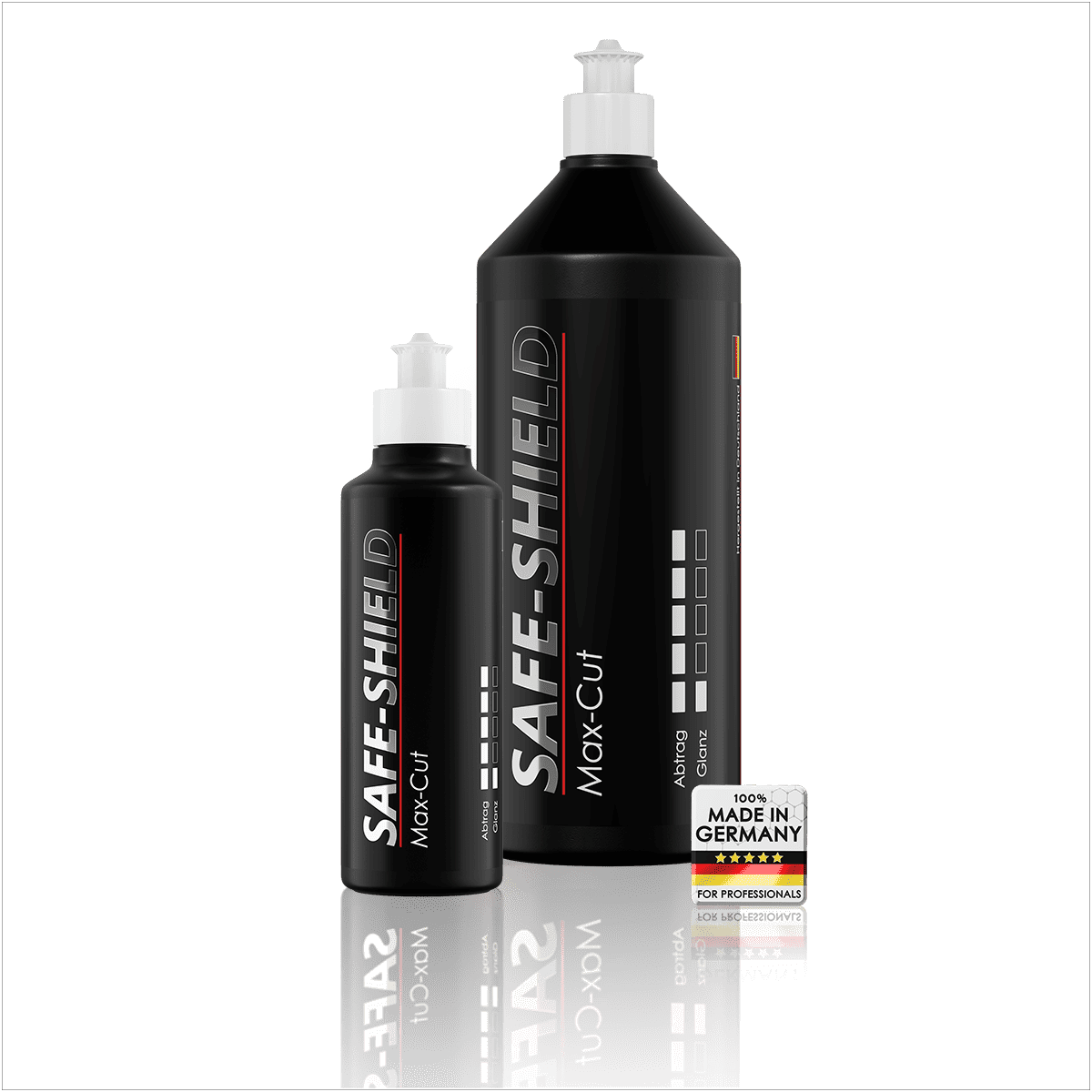
For more noticeable paint defects, you need greater cutting power; for fine polishing marks and a deep gloss, use a finishing polish. Black-One sits between the two: it can remove light to moderate defects while leaving a good finish. Choose according to the condition of your paint, rather than the number of bottles on your shelf.
The right polish saves unnecessary work. Well-maintained paint does not need an aggressive cutting stage before it can shine again. Conversely, a very fine polish soon reaches its limits on more pronounced scratches.
When is Perfect Finish enough?
If your paint already looks good but fine polishing marks or holograms affect the gloss, our Perfect Finish polish is a suitable starting point. It is designed to produce a clear, glossy finish with a fine abrasive action.
On many paint finishes, combine it with the Perfect Finish Polishing Pad. For very soft, dark and sensitive paint, we recommend the Ultra Soft Pad. It is specifically designed for a very fine finish with as few holograms as possible.
A finishing polish is also abrasive, so it removes material. It is neither a gloss-only product nor a durable paint protectant. Depending on the paint, it may not sufficiently improve more pronounced scratches. For dark vehicles in particular, see Which polish should you use on a black car?.
When is Black-One the right middle ground?
For light to moderate wash-induced scratches, it is worth testing Black-One with the Medium One-Step Pad. This combines defect correction and final gloss in one polishing stage, provided the combination works well on your paint.
For a daily driver, this can be a good approach: the paint looks noticeably better without automatically needing two or three stages. Inspect the cleaned test area under a light to see whether further finishing would be worthwhile.
With Black-One, ‘one-step’ does not mean that paint protection is included. Apply protection separately afterwards. To plan one or two polishing stages, see One-step or two-step polishing.
When should you use Max Cut?
Our Max Cut cutting compound is designed for greater material removal. Consider it when a milder combination does not sufficiently improve the existing defects and the paint can safely tolerate more intensive correction. A suitable starting point is the Max Cut Polishing Pad.
Inspect the result after the cutting stage. If fine haze or polishing marks remain, follow with Perfect Finish on a separate, clean finishing pad. Black-One does not automatically need to be used as an intermediate stage.
A deep scratch is not a reason to keep increasing the cutting power. Scratch depth alone cannot tell you how much paint remains or how it has previously been treated. We explain the limits in Removing scratches from car paint.
How do you choose the right polish without endless trial and error?
- Inspect the clean paint. Are you dealing with fine polishing marks, numerous light wash-induced scratches or isolated deeper damage? Do not rely on touch alone: a smooth surface can still have visible scratches.
- Choose a suitable starting combination. Use a finishing polish for fine marks, or a one-step polish for light to moderate defects. Increase the cutting power only when it is actually needed.
- Test a small area. Our guide to polishing a test spot explains how to compare combinations fairly and assess the result.
- Inspect after wiping off. Remove polishing oils from compatible paint and inspect under light from several angles. If the finish remains clear, continue with that combination.
The pad is always part of the decision. A fine polish on an unsuitable or dirty pad will not automatically produce a fine finish. Our guide to choosing polishing pads explains the relationship.
If you would like to try all three stages first, the polishing system test kit with five pads and three polish samples is an option. Choose the correct pad size for your machine and add the spare pads you actually need for larger areas.
After polishing, protect the result in a way that suits how you use your car. Our guide to wax, polymer sealants and ceramic coatings explains the differences.
Frequently asked questions
Is a cutting compound the same as a regular car polish?
Both can be abrasive. A cutting compound usually means a product with a stronger cutting action. Product terminology varies between manufacturers; what matters is its purpose and the actual result.
Can a finishing polish remove wash-induced scratches?
Depending on the paint, very fine marks can be improved. For more pronounced wash-induced scratches, the cutting action may be insufficient. Test a suitable combination on a small area.
Does Max Cut always need to be followed by Perfect Finish?
Inspect the cleaned surface. If fine marks or haze remain, a finishing stage makes sense. There is no need for a fixed three-stage process.
Can I use different polishes on different panels?
Yes. Paint condition and repainted areas can vary. Treat more pronounced defects locally rather than using an unnecessarily aggressive combination on the entire car.
Is a high-gloss polish the same as a paint sealant?
No. A dedicated finishing or high-gloss polish improves the surface through fine abrasive action. Plan durable paint protection separately; combination products must explicitly include a protective component.

Leave a comment
All comments are moderated before being published.
This site is protected by hCaptcha and the hCaptcha Privacy Policy and Terms of Service apply.