
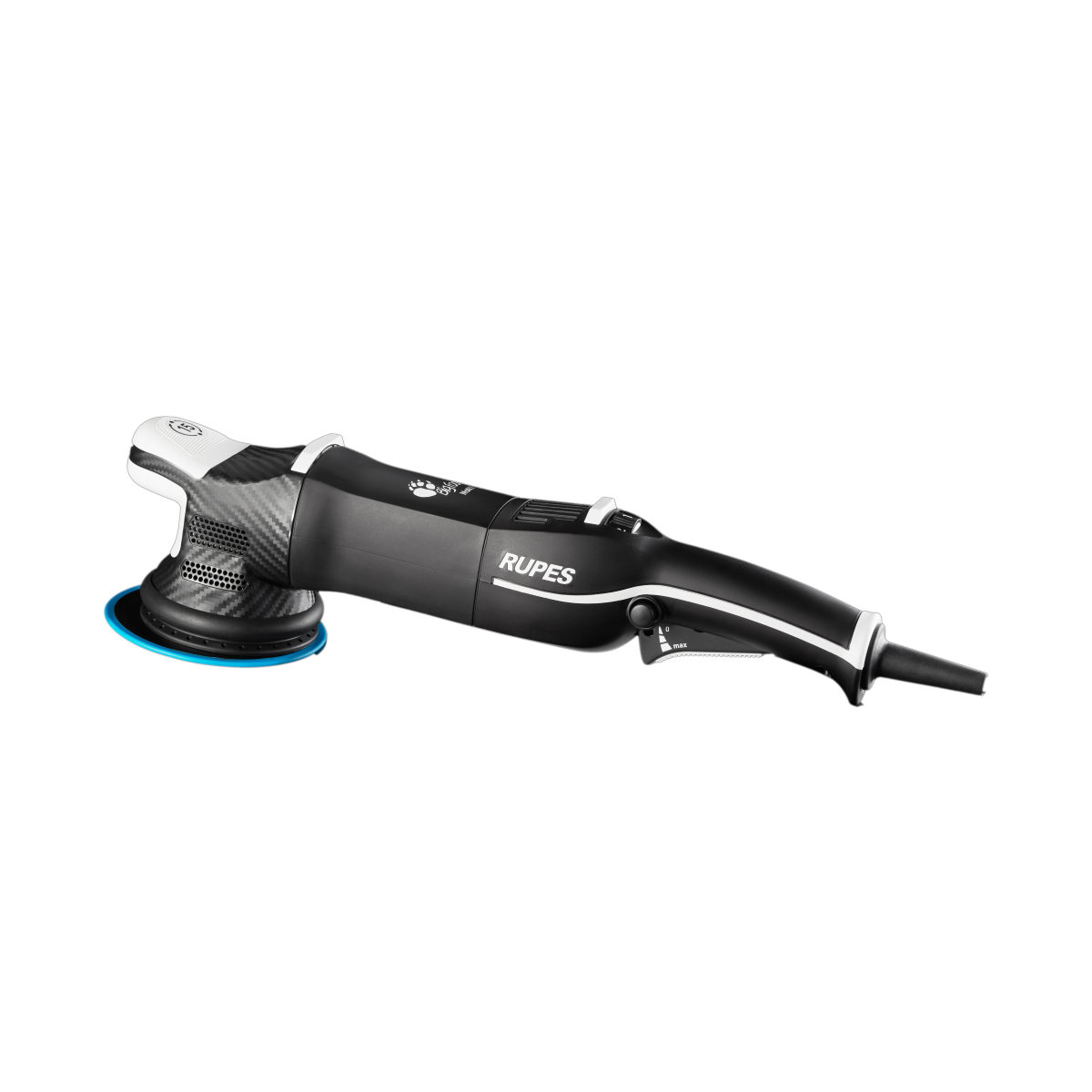
The right speed and pressure depend on the machine, pad, polish and paint. Start within the specified application guidance, with little additional pressure, a flat pad and a setting you can control easily. A test spot shows whether scratches improve and the finish is suitable. ‘Always use speed six’ is not a useful rule.
Speed does not mean the same thing on every machine
A rotary polisher directly turns the backing plate around its axis. A free-spinning dual-action machine combines orbital motion with free backing plate rotation. On a gear-driven dual-action machine, rotation is additionally driven. Speed figures and control settings therefore cannot be directly transferred between different tools.
The dial setting is not a standard unit either. Setting three on one machine need not produce the same movement or effect as setting three on another. We compare drive types in Dual-action or rotary polisher.
Finding a suitable setting
- First choose a polish suited to the defects and a pad intended for it. Start on cool, clean paint.
- Spread a small amount of product over the area using a suitable low setting, without splattering it.
- Then work at a specified operating setting you can control well. Move the pad slowly and evenly in overlapping passes.
- Wipe off residue and inspect the test spot. Change only one variable at a time: setting, pressure, combination or working time.
For light to moderate defects, Black-One with the Medium One-Step Pad is a possible starting point. Our test spot guide explains how to compare the result.
How much pressure makes sense?
Guide the machine steadily without forcing it into the paint. Keep the pad as flat as possible. On a free-spinning dual-action machine, high pressure can slow free rotation; tilting the pad and pronounced contours can also contribute. The orbital motion may continue while rotation stalls.
Observe the visible backing plate movement rather than equating motor noise with effective movement. A stalled plate is not a reason to press harder. Adjust your technique or choose a tool suited to the surface. Switch off in the event of a mechanical stoppage or unusual noises.
When should you take a break?
If polish dries prematurely, the pad becomes clogged or the surface gets progressively warmer, stop. Let the panel and pad cool, check the product amount and use a fresh pad if needed. There is no single universally safe temperature for every paint finish and component.
Heat does not come from the dial setting alone. Pressure, time spent in one spot, pad and substrate all interact. Controlled work is particularly important around edges and thin paint. For pad care, see Cleaning polishing pads.
Cutting and finishing require different decisions
More speed or a firmer pad is not a shortcut for every paint finish. If Max Cut sufficiently corrects the more pronounced defects on the test spot, plan a subsequent finishing stage with Perfect Finish and a suitable soft pad.
Finishing aims for a clear surface without introducing new fine marks. A gentler combination may achieve more than additional pressure here. For sensitive paint, consider the Ultra Soft Pad. The comparison Cutting compound or finishing polish explains the different tasks.
Frequently asked questions
Is there a perfect polishing speed for every car?
No. Drive type, pad, polish and paint need a suitable combination. Decide based on the test spot and the specified application guidance.
Is a dual-action polisher harmless if I press hard?
No. A dual-action machine can also generate heat and remove material. High pressure is not a safety strategy.
Should I move faster across the paint when the machine runs faster?
Not automatically. Use even, overlapping passes and assess the result rather than arbitrarily increasing movement speed and machine speed together.
Why does my dual-action backing plate barely rotate?
Excessive pressure, a tilted pad or surface shape can slow free rotation. Check your technique and appropriate pad size first.

Efterlad en kommentar
Alle kommentarer er modereres, før de bliver offentliggjort.
'Denne side er beskyttet af hCaptcha, og hCaptchas Politik om beskyttelse af persondata og Servicevilkår er gældende.