
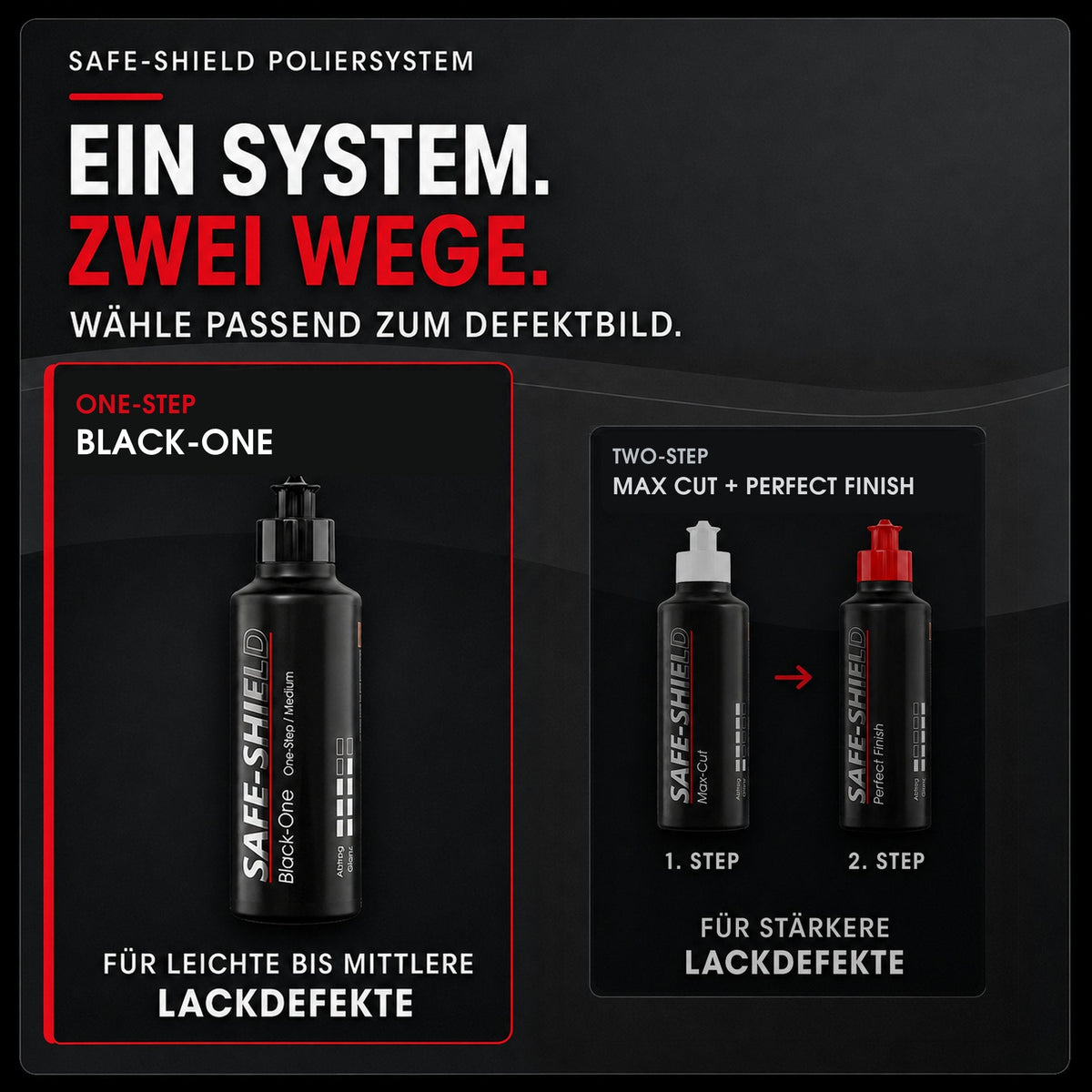
A one-step polish is sufficient if it reduces the desired defects and already leaves a clean finish. Two-stage polishing makes sense if you need to carry out stronger correction and subsequent gloss refinement separately. Which option is suitable is shown by a test spot on your paint – not by vehicle age or color alone.
With our Black-One you can tackle light to moderate defects and gloss in a single polishing step. For more correction there is Max Cut followed by a finishing pass with Perfect Finish. Here we explain how to choose between these approaches without removing more paint than necessary.
What is a one-step polish?
In a one-step process, you work the area with a polish-and-pad combination that provides sufficient correction and at the same time produces the desired finish. A separate pass with a finer combination is omitted. “One step” does not mean just pulling the machine over the paint once: even a single polishing stage consists of controlled work in overlapping passes.
Our Black-One One-Step Polish is designed to combine defect correction and gloss. It is also classified as a medium polish because it sits between heavier cut and fine finish. The level of correction you achieve also depends on the pad, machine, paint and technique.
One-step is not automatically a polish with built-in sealant
The term does not mean the same thing with every provider. There are combination products that also apply protective components. In the process described here, one-step stands for correction and finish; you plan the paint protection separately afterwards. That way you can first check the actual polishing result and then choose the appropriate protection. The difference is explained in Waxing or polishing.
When is a one-step polish enough – and when does a two-step process make sense?
One-step: light to moderate defects and a realistic goal
You want to reduce fine wash marring and restore more clarity to the paint without chasing every deeper individual scratch? Then Black-One with the Medium One-Step Pad is a sensible test. If the dry, residue-free surface looks good, there is no reason to automatically add another polishing stage.
Two-step: more correction needed, then refine the finish
If the mild combination is not enough for safely correctable defects, a stronger cut may be necessary. This first step focuses on removal. The second step refines any fine traces of the correction. In our system, this is done with the combination of Max Cut and Perfect Finish.
What matters is whether the paint condition allows further correction. A deep defect will not automatically become repairable through an additional polishing step. If you’re unsure whether material is missing or the scratch can still be sensibly corrected, our guide Removing scratches from car paint: possibilities and limits will help.
Finish only: when heavier correction is not needed at all
For fine polishing marks or a light finish haze, Perfect Finish with a suitable soft pad may already be sufficient. This is also a single-step process, even though you are not using a medium polish. Choose the mildest combination that achieves your goal instead of removing more clear coat than necessary as a precaution.
How to decide with a test spot
- Clean and inspect the paint. Assess a clean, dry and cooled-down surface under a suitable inspection light. This decision aid applies to intact gloss paint, not to matte paint or film.
- Select a small test area. A manageable flat spot of about 40 × 40 cm helps you compare the result. Start with the mildest combination that you still expect to be effective.
- Polish in a controlled way. Spread the polish and work the area according to the product and machine instructions. More product, pressure or working time are no substitute for a suitable combination.
- Remove residues. Wipe off the polish with a clean, soft cloth. For subsequent inspection on suitable surfaces you can use our Ultra Degreaser as directed to remove polishing oils.
- Assess correction and finish separately. Have the bothersome scratches been sufficiently reduced? Is the surface also clear? Only once you can answer both questions do you decide on another step.
If necessary, test a neighboring area with a different combination. Repeatedly working more aggressively on the same test spot increases removal there and makes a fair comparison harder. Different components can also react differently, for example after a repaint.
Our matching combinations
For one-step: Black-One and Medium One-Step Pad
Black-One with the Medium One-Step Polishing Pad is our matched starting point for correction and high gloss in a single stage. Have several clean pads ready so the result stays as consistent as possible across the whole vehicle.
For cut and finish: Max Cut and Perfect Finish
For the correction step, first combine Max Cut with the Max Cut Pad. Then inspect the area. If refinement is needed, follow with Perfect Finish on a dedicated Perfect Finish Pad. Black-One is not a mandatory intermediate step.
To compare different combinations, our polishing system test kit is ideal. You’ll find the differences between pad types in Which polishing pad for which polish?.
How do effort and material requirements differ?
Two stages mean additional polishing, wipe-off and inspection, plus separate pads. However, the total effort is not automatically twice as high: repeatedly using an unsuitable one-step combo can be more work than doing a proper correction followed by a finish. Use the test spot to estimate the time your plan will actually take.
For a daily driver, aim for a realistic result. A significantly improved overall finish with some deeper isolated defects remaining can be more sensible than maximum defect removal. You’ll find the full process in our guide to polishing your car.
Frequently asked questions about one-step and two-step
Can I remove all scratches with a one-step?
No. The possible correction depends on defect depth and paint condition. Deep damage may not be sensibly or fully removable even with a stronger polish.
Does black paint always need two polishing stages?
No. Fine marks are more easily visible on dark paint, but the color alone does not determine paint hardness or the required process. Check correction and finish on a test spot.
Does “two-step” always mean heavy and medium cut?
No. The stages are chosen based on their task. Often it’s a stronger correction followed by a fine finishing pass. Two passes with the same combo are not two different polishing stages.
Can one-step be sufficient as preparation for ceramic coating?
Yes, if the result is good and the surface is then prepared according to the coating’s specifications. An additional finishing stage is not a blanket requirement. More on this in Polish before ceramic coating.

Efterlad en kommentar
Alle kommentarer er modereres, før de bliver offentliggjort.
'Denne side er beskyttet af hCaptcha, og hCaptchas Politik om beskyttelse af persondata og Servicevilkår er gældende.