
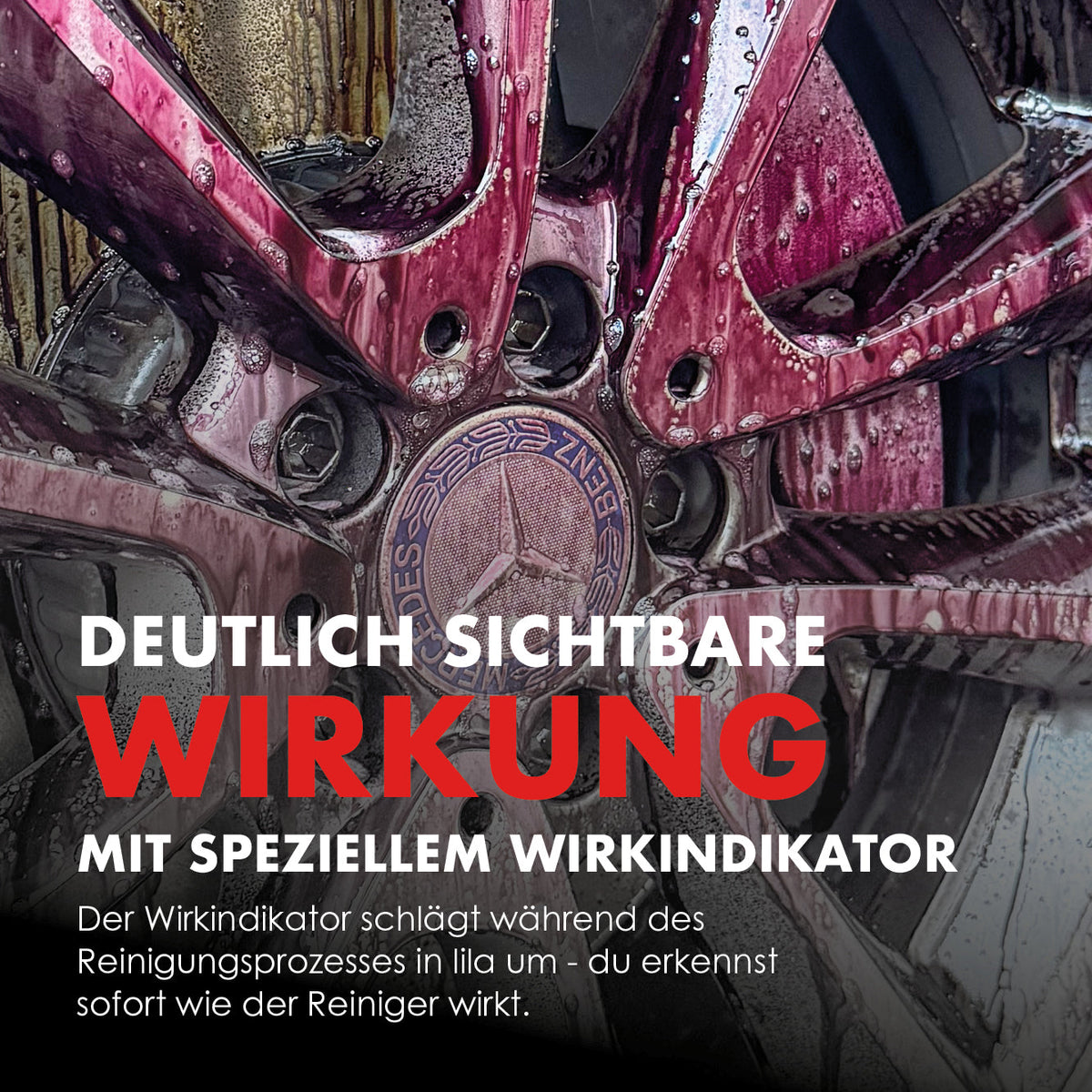
You will not reliably remove baked-on brake dust by simply letting the cleaner dwell longer or scrubbing harder. First check whether there is actually a deposit on the wheel. Then combine a wheel cleaner suitable for the surface with controlled follow-up cleaning. If the coating is already damaged, cleaning cannot undo the damage.
This guide helps if dark spots, rough areas, or a grey film remain after a normal wash. You can find the full process for regular care in our guide to proper wheel cleaning.
Is the brake dust really baked in?
In everyday language, “burned in” is often used for any dirt that doesn’t come off during the first wash. On its own, however, the term doesn’t describe either the composition of the residue or the condition of the surface. Brake dust, road film and other deposits can overlap.
First clean the wheel gently, rinse it thoroughly and inspect it in good light. Its appearance provides clues, but no reliable remote diagnosis:
- Dark, uniform film: May be remaining dirt, especially in the hard-to-reach inner barrel of the wheel.
- Individual dark spots: Tar splashes are often a possible cause, especially if a few stubborn black dots remain after washing. However, they can also be other particles; colour alone is not enough to tell the difference.
- Cloudy areas, blisters or flaking clear coat: Indicate that there is also or instead a problem with the coating itself.
- Changes to stone chips and edges: In those areas, the condition of the coating should be checked before any further chemical treatment.
Removing stubborn brake dust in a targeted way
1. Check the surface and previous application
Only work on a cool wheel in the shade. Check whether the cleaner used is intended for the specific surface. With unknown coatings, polished or anodised finishes and existing damage, do not increase cleaning strength on speculation.
Also check the simple cause: Did you actually reach the wheel barrel? Did the cleaner wet all dirty areas? Was the product used according to the label? A missed area first needs a clean working process, not automatically different chemicals.
2. Use a suitable cleaner in a controlled way
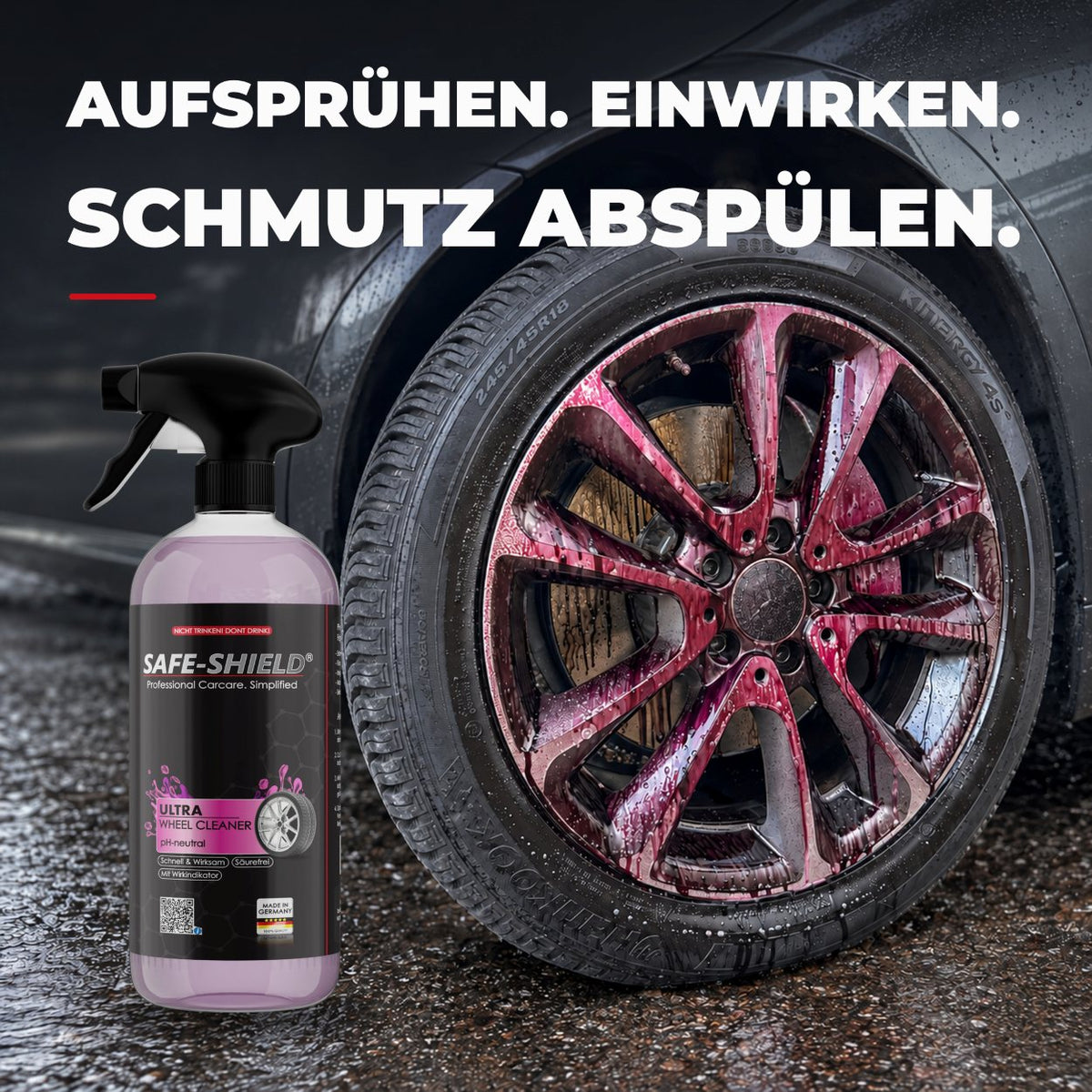
The Ultra Wheel Cleaner for wheel cleaning loosens brake dust and road grime. Use it according to the current label instructions, check compatibility and do not let it dry on. Wear suitable protective gloves and observe the other product information.
The purple reaction indicator reacts with iron-containing contamination. It does not show all dirt, nor does it indicate the exact moment when the wheel is completely clean. Therefore, observe the specified dwell time even if you expect stronger discoloration.
3. Rinse off and clean targeted areas
Rinse off the cleaner completely. Then remove remaining dirt with suitable shampoo water and clean tools appropriate for the surface. Keep the area wet and work with light pressure.
For narrow gaps between spokes, a flat wheel brush with microfiber cover is useful, provided it can pass through freely. Accessible areas can be cleaned with a separate wheel wash mitt. Rinse tools frequently; embedded dirt must not be dragged across the wheel.

4. Assess the result instead of repeating endlessly
Rinse again and inspect the area. If residues are visibly reduced and the surface remains unchanged, another treatment within the product instructions may be an option. It is not sensible to specify a blanket number of passes.
If there is no change at all, stop and investigate the cause. Unsuitable chemistry, a different type of deposit and surface damage each require different solutions. Simply extending dwell time indefinitely is no substitute for this distinction.
Black individual dots: tar spots instead of brake dust?
If stubborn individual black dots remain, they may be tar spots. These road residues are a common possible cause and will not necessarily dissolve with an iron remover for brake dust. That’s why simply increasing the dwell time is not automatically the solution.
On an intact, smooth and glossy painted wheel surface, suitable detailing clay or a clay pad can help gently remove stubborn tar spots. A handy alternative to traditional clay is our Clay Sponge – clay and paint cleaning sponge. First check suitability for the specific coating and test in an inconspicuous area.
- Thorough pre-cleaning: Wash the wheel and rinse it completely. Loose sand and dirt must be removed before you start claying.
- Use plenty of lubricant: Keep the area and the clay surface constantly well wetted. For the Clay Sponge, for example, Wash & Foam shampoo water can be used as per the product instructions. Never work dry.
- Work locally with light pressure: Glide clay or sponge over the residue in short, straight motions. Check in between whether the spot is dissolving and the surface remains unchanged.
- Keep the claying surface clean: With traditional clay, regularly fold to expose a clean surface; clean the clay sponge according to its instructions. Do not continue using a dropped pad on paint.
- Rinse and inspect: Remove residues and check the result in good light. If the spot does not come off gently, stop trying.

You can find more on the process in our guide to paint cleaning with detailing clay.
Why doesn’t the wheel cleaner work as expected?
The wrong area is being treated
The front of the wheel looks clean, but a grey ring remains in the barrel: in that case, accessibility may be the issue. A suitable tool or professional cleaning with the wheel removed may make more sense than a harsher product. If you lack experience, leave removal and refitting of wheels to a professional shop.
The residue is not typical brake dust
A product for iron particles is not automatically a specialist cleaner for every other type of contamination. Before changing products, you must clarify the type of residue and material compatibility. Our guide to choosing pH-neutral, acid-free and acidic wheel cleaners explains the differences.
The dirt is gone, but the surface remains altered
A dull spot does not necessarily mean that more cleaner is needed. If the coating is already attacked or undercut, further cleaning can make things worse. This is especially true at damaged edges and areas with exposed base material.
What you should avoid with baked-on brake dust
- Oven cleaner, vinegar and scouring agents: Without explicit approval for the specific wheel surface, they are not a controllable substitute solution.
- Metal brushes and abrasive sponges: They can damage the surface along with removing the contamination.
- Letting cleaner dry on the surface: More dwell time does not automatically mean more effective cleaning performance.
- Mixing multiple cleaners: Only use products separately according to their instructions and rinse completely in between.
- Polishing blindly: Polishing removes material and is not a universal solution for all wheels. In particular, matte surfaces must not be polished to a gloss.
In the case of flaking, blisters, unclear discoloration or still stubborn residues, a detailing specialist or wheel repair shop should assess the area. The goal is a clean, intact wheel – not a spot removed at any cost.
Making the next cleaning easier
Remove visible deposits regularly before they remain on the wheel for a long time. Include the wheel barrel and the backs of the spokes as far as they are accessible. Keep wheel tools separate from paint wash tools and store them clean and dry.
If you’re missing a cleaner and suitable tools, the Wheel Cleaning Kit Essential combines wheel cleaner, FingerFit microfiber gloves and a flat brush. The XXL Wheel Cleaning Kit adds more brush sizes, a wheel mitt and a detailing brush. You’ll also need shampoo, a bucket and suitable chemical-resistant gloves.
Q&A: Stubborn brake dust
Can you remove baked-on brake dust completely?
That depends on whether there is a removable deposit and whether the coating is still intact. A complete removal cannot be promised across the board. Cleaner does not repair an already damaged surface.
Does a longer dwell time help against black spots?
Do not extend the dwell time beyond the product specification. Black dots can have different causes. After the permitted dwell time, rinse thoroughly and assess the remaining residue.
Can detailing clay remove black tar spots from wheels?
On suitable, intact and glossy painted surfaces, detailing clay or a clay sponge can remove stubborn tar spots. Clean thoroughly beforehand, use plenty of lubricant and work with light pressure. Test first in an inconspicuous area: claying can leave fine marks. It is not a blanket recommendation for matte, unprotected or damaged surfaces.
Why does dirt remain even though the cleaner turns purple?
The indicator shows the reaction with iron-containing contamination, not the complete removal of all residues. Other deposits and poorly reached areas can remain.
Is an acidic cleaner the next step?
Not automatically. What matters are the type of deposit, the surface and the product’s explicit approval. Switching to a different pH range without this check can stress the wheel without solving the problem.
What should I do if the wheel looks dull after cleaning?
Rinse off all product residue and stop further attempts. Have it checked whether residues or surface damage are present. Do not use polish or stronger cleaners on speculation.

Deja un comentario
Todos los comentarios se revisan antes de su publicación.
Este sitio está protegido por hCaptcha y se aplican la Política de privacidad de hCaptcha y los Términos del servicio.